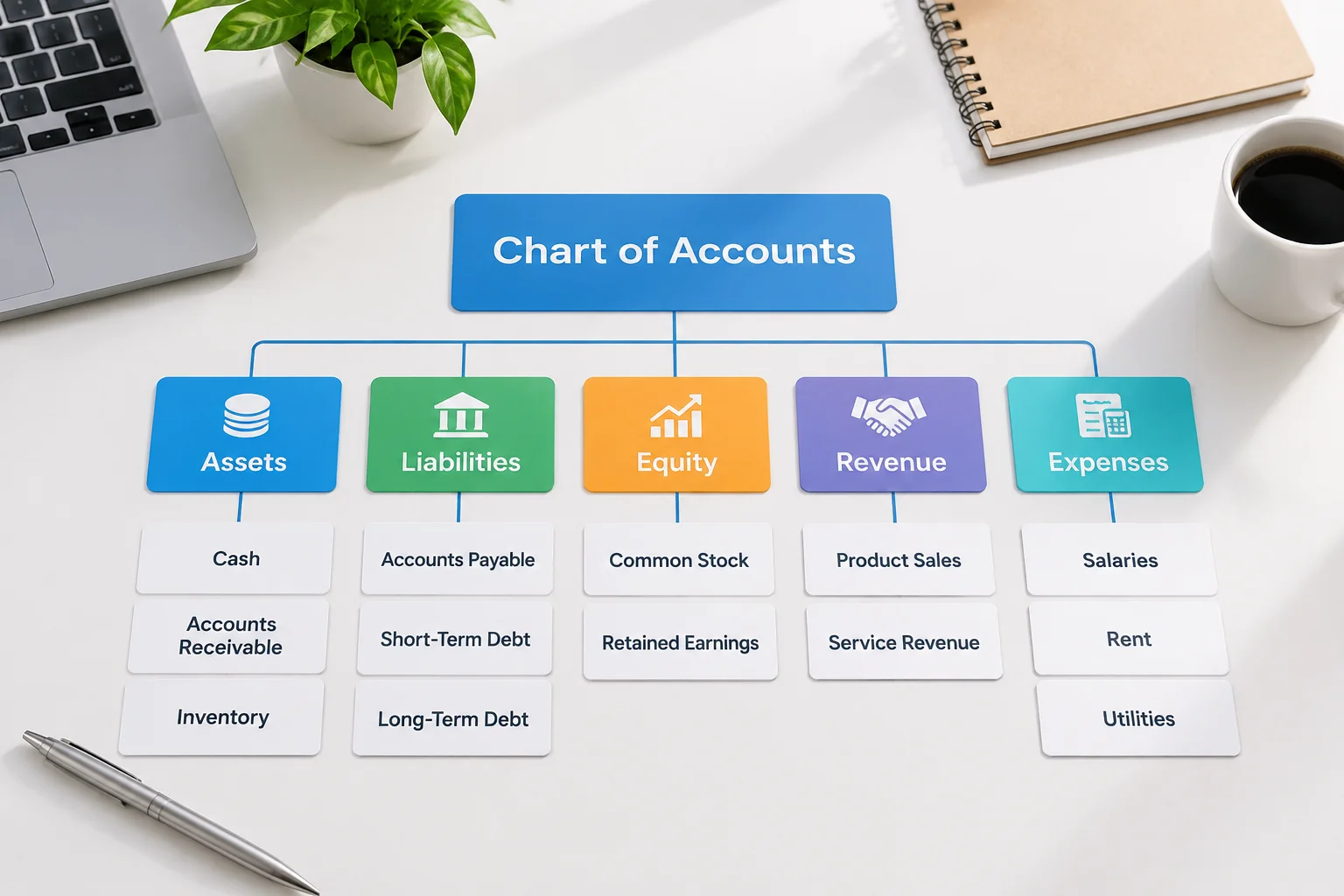

Structural Architecture & Operational Parameters
Account Hierarchy Specifications
- Maximum Branch Depth
- 5 Tier Levels
- Balance Inheritance
- Bottom-Up Rollup
- Root Account Classes
- 5 Primary Groups
- Code Mask Format
- 4-Digit Segmented
Engineering the Chart of Accounts Hierarchy
Building a resilient chart of accounts requires treating the ledger not as an arbitrary list of names, but as a directed acyclic tree with defined mathematical propagation rules. In this structure, every node operates either as an aggregation container or as an active posting node where financial transactions settle. Direct postings to summary parent nodes are strictly prohibited to maintain reporting clarity across consolidated statements.
Grouping accounts into distinct numeric ranges ensures that subordinate branches inherit the properties of their parent categories automatically. An asset branch numbered in the 1000 range, for instance, passes its left-normal balance rules down to cash, receivables, and inventory sub-accounts. Assigning dedicated numbering intervals creates space for institutional expansion without disrupting established reporting queries.
Fundamental Account Tree Principles
- Maintain strict separation between summary header accounts and transaction posting accounts.
- Assign consistent numeric ranges to primary groups (Assets 1000, Liabilities 2000, Equity 3000).
- Validate bottom-up balance aggregation before generating general ledger trial reports.
When restructuring legacy account trees, archiving inactive branches protects audit trails while keeping active reporting views uncluttered. Child nodes must be reconciled and settled to zero balance before parent classifications are shifted. The Account Tree Builder provides a visual laboratory to test these hierarchical transformations prior to executing permanent modifications in production environments.
Verification Mechanisms & Balance Integrity
“A chart of accounts forms the conceptual skeleton of an enterprise; when its hierarchy is sound, financial reporting becomes transparent and mathematically verifiable.”
Dynamic verification ensures that balance sheet symmetry remains intact across all branch consolidations. By checking normal left entry balances against contra-accounts and alerting users to polarity anomalies, the tree builder prevents miscategorized entries before they reach the general ledger. This systematic approach guarantees dependable trial balance outputs and simplifies multi-entity rollups.
Technical Inquiries & Taxonomy Discussion
Connect with our academic research contributors to discuss double-entry structural taxonomy and ledger engineering standards.